

Case Study: Breast Reduction With Severe Sagging

When Breast Size and Gravity Take a Toll
Not every breast reduction starts from the same place. Some patients come in with moderate fullness and mild drooping. Others arrive with breasts that have stretched well beyond the ribcage over many years. This patient fell into the second category.
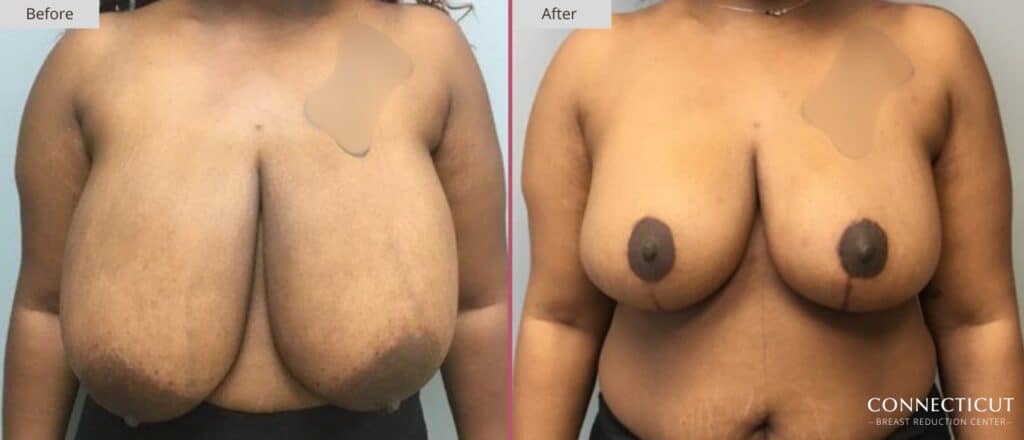
When she came to the Connecticut Breast Reduction Center, her breasts hung well past her ribcage. Her nipples pointed straight down toward the floor rather than forward. Years of carrying that weight had stretched the skin so severely that dark hyperpigmentation had developed along the underside of each breast. This type of skin discoloration is common when tissue folds remain in constant contact with each other over long periods. The friction and moisture trapped beneath heavy breasts can irritate the skin, cause darkening, and sometimes lead to chronic rashes or infection.
Her case required more than a simple reduction in volume. It called for a significant reshaping of the entire breast, along with a major repositioning of both nipples.
What Severe Ptosis Means for Surgery
In plastic surgery, the term “ptosis” refers to how much a breast has drooped from its natural position on the chest wall. Mild ptosis means the nipple has dropped slightly below the breast crease. Severe ptosis, like this patient had, means the nipple sits well below the crease and often points downward instead of forward.
The degree of ptosis matters since it changes what the surgery needs to accomplish. A patient with mild sagging may only need tissue removed and a small lift. A patient with severe ptosis needs the nipple moved several inches upward while still preserving its blood supply and nerve connections. That is a more complex procedure, and it demands careful surgical planning.
Many women with severe sagging put off their consultation. They assume their situation is “too extreme” for a good result. That is rarely the case. Modern breast reduction techniques can address even the most advanced ptosis and produce a natural, balanced outcome.
How We Approached This Procedure
During surgery, we removed a substantial amount of tissue from both breasts. The goal was not just to reduce size but to create a shape that would sit at a natural position on her chest wall.
The most critical part of this procedure was the nipple repositioning. Since her nipples pointed straight down, they needed to be lifted several inches and redirected to face forward. This step requires precision. The nipple and areola must be moved on a pedicle, which is a stalk of tissue that keeps the blood supply and sensation intact during the lift. The longer the distance the nipple must travel, the more carefully the surgeon must plan the pedicle design to avoid complications.
We also had to manage a significant amount of excess skin. When breasts have been heavy and low-hanging for years, the skin envelope is stretched far beyond what the new breast shape requires. Removing that excess and closing the incisions in a way that supports the new contour is essential to a lasting result.
The Role of Skin Health in Breast Reduction
The hyperpigmentation on this patient’s skin tells an important story about what years of macromastia can do to the body. When large, heavy breasts rest against the torso, the skin underneath stays warm and moist. Over time, this leads to friction damage, pigment changes, and sometimes fungal or bacterial skin infections.
These skin issues often resolve on their own after breast reduction surgery. Once the breast no longer folds over and traps moisture against the body, the skin can heal. Hyperpigmentation may fade gradually over the months following the procedure. For many patients, the relief from chronic skin irritation is one of the most immediate quality-of-life improvements they notice after surgery.
The Result
The outcome for this patient speaks for itself. Her breasts now sit in a compact, lifted position on her chest. The nipples face forward at a natural height. The overall shape is proportional and balanced in a way that was not possible before the procedure.
Results like this do not happen by accident. They require a surgeon who understands how to handle severe ptosis, manage excess skin, and reposition the nipple complex across a significant distance without compromising blood flow or sensation.
Is Your Situation Similar?
If your breasts hang well below your ribcage, if you deal with skin irritation or discoloration underneath them, or if you have been told your case is “too severe” for a good result, you may be a strong candidate for the type of procedure this patient had. The Connecticut Breast Reduction Center specializes in exactly these cases.
Every consultation starts with an honest evaluation of your anatomy, your goals, and the surgical plan that would deliver the best result for your body. Contact us today to schedule yours.