
Case Study: Breast Reduction With Major Tissue Resection

How Much Tissue Can Be Removed During Breast Reduction?
It is one of the most common questions patients ask during a consultation. They want to know whether their surgeon can remove enough tissue to make a real difference. A conservative reduction may not go far enough to relieve symptoms or create the proportional change they need.
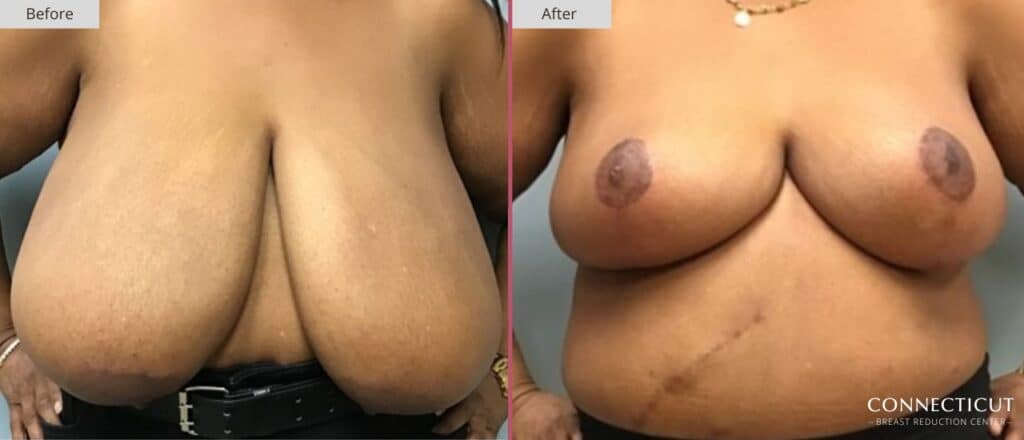
This patient is a perfect example. She arrived at the Connecticut Breast Reduction Center with extremely pendulous breasts that reached nearly to her waistline. The weight she had been carrying for years placed constant strain on her body.
Surgery required a major tissue resection on both sides, along with a full lift that repositioned both nipples high on the chest wall. The final outcome is a dramatically smaller chest that matches the proportions of her torso for the first time.
The Physical Cost of Excess Breast Weight
The average breast weighs between 0.5 and 2 pounds. When breast tissue grows well beyond that range, the numbers add up fast. A woman carrying several extra pounds on her chest is essentially wearing a weighted vest every hour of every day. That load does not just cause discomfort. It changes the way the body moves and functions over time.
The spine compensates for the forward pull by shifting posture. Shoulders round inward. The neck and upper back muscles stay in a constant state of tension to keep the body upright. Over months and years, this leads to chronic pain that does not respond well to physical therapy, chiropractic work, or over-the-counter medication. The root cause is mechanical, and it stays until the weight is removed.
Breasts that reach the waistline also create practical challenges that go beyond pain. Exercise becomes difficult or impossible. Clothing options shrink. Bra straps dig into the shoulders and leave permanent grooves. For many patients, these daily frustrations are just as motivating as the physical symptoms.
What Major Tissue Resection Involves
Not all breast reductions remove the same amount of tissue. A standard reduction might remove 300 to 500 grams per breast. A major resection can remove well over 1,000 grams per side, sometimes significantly more. The distinction matters since the surgical approach has to account for the volume being taken out.
When the resection is this large, the surgeon must think carefully about several factors at once. First is blood supply. More tissue removal means more disruption to the internal vascular network. The pedicle that carries blood to the nipple must be designed to stay intact even after a significant portion of the surrounding tissue is gone.
Second is skin management. A breast that reaches the waistline has a massive skin envelope. After the tissue is removed, that extra skin must be reshaped and tightened around the new, smaller breast mound. If too much skin is left behind, the result looks deflated. If too much is removed, the closure is too tight and healing suffers. Getting this balance right is one of the most skill-dependent parts of the procedure.
Third is nipple placement. In a case like this one, the nipples sat extremely low before surgery. They needed to travel a significant distance upward to reach the correct position on the chest wall. The lift portion of the procedure handled this, and both nipples were repositioned high enough to create a natural, forward-facing projection.
Why Proportion Matters More Than Cup Size
Many patients walk into a consultation with a target cup size in mind. While that is a helpful starting point, the real goal of breast reduction is proportion. Two women can wear the same cup size and look completely different depending on their frame, shoulder width, ribcage circumference, and torso length.
This patient’s result demonstrates what proportional balance looks like. Her breasts are not just smaller. They are scaled to her body in a way that looks natural and balanced from every angle. That kind of outcome requires the surgeon to evaluate the whole frame during the planning stage, not just the breast tissue itself.
A good breast reduction does not aim for the smallest possible result. It aims for the result that fits the patient’s body. In this case, that meant a dramatic reduction in volume paired with a full lift to reposition everything where it belongs.
The Result
The transformation for this patient is striking. Where her breasts once hung to her waistline with extreme pendulosity, they now sit high on the chest wall in a compact, proportional shape. The difference in contour is immediately visible, and the physical relief from removing that much tissue is substantial.
This type of result requires experience with high-volume resections. The margin for error is smaller when more tissue is involved, and the surgical plan must account for skin management, nipple viability, and final shape all at once.
Could Breast Reduction Help You?
If your breasts feel disproportionately large for your frame, if the weight causes daily pain or limits your activity, or if you have been told you need a major reduction, you are in the right place. The Connecticut Breast Reduction Center has extensive experience with large-volume tissue resection and the complex lift procedures that go with it.
Schedule a consultation to find out what is possible for your body and your goals.