

Case Study: Breast Reduction That Preserves Fullness and Curves
When You Want Smaller but Not Flat
Not every patient who comes in for a breast reduction wants to go as small as possible. Some women want relief from the weight and the pain, but they also want to keep curves that feel like them. That balance is one of the most important conversations that happens during a consultation. And it is one of the hardest things to get right in surgery.
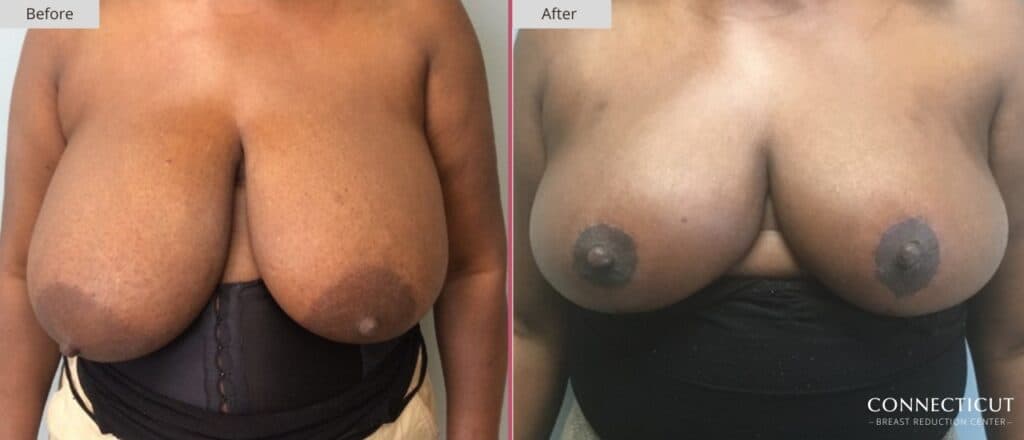
This patient is a great example. She came to the Connecticut Breast Reduction Center carrying breasts heavy enough that she wore a corset in her before photo just to manage the daily weight. That level of support is not something most people think about. It means that even getting dressed and standing upright required external reinforcement. The physical burden was constant.
But she was not looking to walk out with a flat chest. She had a curvy frame, and she wanted to keep that. Her goal was to ease the physical burden without losing the feminine shape she identified with. That made the surgical plan more nuanced than a standard high-volume reduction.
The Corset Tells the Story
It is easy to overlook a detail like the corset in the before photo. But it says a lot about what this patient was dealing with on a daily basis.
When breasts are heavy enough to require that kind of structural support, basic activities become harder than they should be. Standing for long periods is uncomfortable. Walking or exercising puts strain on the back, neck, and shoulders. Even sitting at a desk can feel exhausting when several pounds of tissue are pulling your upper body forward all day.
Most bras are not built for that kind of weight. Straps dig into the shoulders. Bands ride up in the back. Underwires bend and lose support within weeks. Many women in this situation layer multiple bras or turn to compression garments and corsets just to get through the day. That is not a clothing problem. It is a medical one.
This patient had reached the point where external support was no longer enough. She needed the weight reduced surgically so her body could support itself without help.
Planning a Reduction Around the Patient’s Goals
This is where the consultation becomes critical. If we had treated this as a straightforward volume reduction and removed as much tissue as possible, the result would have been smaller but would not have matched what she actually wanted. She would have lost the curves and fullness that were important to her.
Instead, we built the surgical plan around her specific goals. The focus was on removing enough volume to ease the physical burden while preserving fullness that matched her curvy frame. That meant being strategic about where the tissue came from and how much stayed behind.
In a case like this, it is not just about grams removed. It is about the distribution of what remains. We needed to leave enough tissue in the right areas to maintain a rounded, full breast shape. The upper pole of the breast especially needed to retain some volume to avoid a hollowed-out look that would not have fit her body type.
At the same time, the lower pole had to be tightened significantly. That is where most of the excess weight and drooping lived. By removing tissue from the lower and central portions of the breast while preserving volume in the upper and outer zones, we were able to bring the weight down without sacrificing the overall shape.
The Lift That Made the Difference
Reducing volume was only half of the equation for this patient. The other half was the lift. Her breasts had been dragged down by their own weight for years, and simply making them lighter would not have been enough to reposition them on the chest wall.
We lifted both breasts dramatically higher during the procedure. The nipples were repositioned to face forward at a natural height rather than pointing downward as they did before surgery. The skin envelope was tightened around the new shape to hold everything in place and create that firm, rounded contour.
The combination of the reduction and the lift is what produced the result she was after. Her breasts are smaller and sit much higher on her chest, but they still look full and natural. There is no hollowness in the upper pole. There is no flattened appearance that sometimes happens when too much tissue is removed from a patient with a curvy build. The shape matches her frame the way she wanted it to.
Why “How Much to Remove” Is Not a Simple Question
Many patients come into a consultation focused on a cup size or a number of grams. Those are useful reference points, but they do not capture the full picture. Two patients can have the same amount of tissue removed and end up with completely different results depending on their frame, their skin quality, and where the tissue is taken from.
For this patient, removing too much would have created a mismatch between her chest and the rest of her body. Removing too little would have left her in the same pain. We had to find the exact middle ground where the weight came down enough to provide relief while the remaining shape still looked like her.
That kind of decision-making happens in the operating room, but it starts in the consultation. When a patient tells us what she wants to keep, not just what she wants to lose, it gives our surgeon the information needed to build a plan that delivers on both fronts.
The Result
The change is dramatic. This patient went from needing a corset to manage her breast weight to having breasts that sit high on her chest and support themselves. The shape is rounded, full, and proportional to her curvy frame. She got the relief she needed without giving up the look she wanted.
That is not a compromise. It is a surgical plan built around a specific patient with specific goals. The result reflects exactly what she asked for during her consultation.
Want a Reduction That Fits Your Body?
Not every breast reduction has the same goal. Some patients want to go as small as possible. Others want to find the sweet spot between relief and shape. The Connecticut Breast Reduction Center plans every procedure around what the individual patient needs and wants.
Contact us today to schedule your consultation and tell us what matters most to you.