
Case Study: Breast Reduction With Stretch Marks

The Skin Tells the Story
Before a patient says a word during a consultation, the skin often tells us everything we need to know about how long the breasts have been heavy and how much strain they have been under. Stretch marks are one of the clearest signs. They form when the skin expands faster than it can keep up with, and on the breasts, they usually mean the tissue has been heavy for a long time.
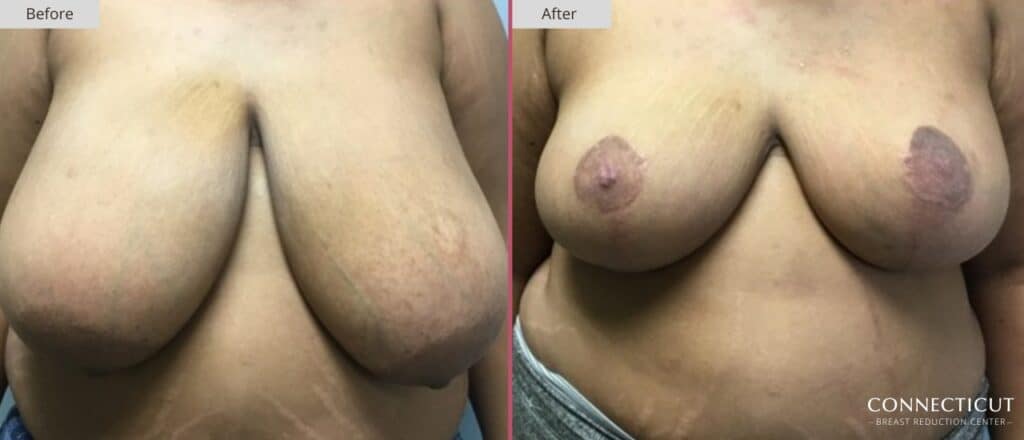
This patient came to the Connecticut Breast Reduction Center with pronounced stretch marks across both breasts and a low-hanging appearance that had developed over years of carrying excess weight. The stretch marks were visible proof of what her body had been dealing with. The skin had been pulled beyond its natural elasticity, and the tissue had settled into a heavy, drooping position on her chest.
She wanted a significant change in size and shape. But with skin that had already been stretched this far, the surgical plan had to account for more than just tissue removal. It had to factor in the condition of the skin itself.
What Stretch Marks Mean for Breast Reduction
Stretch marks form in the dermis, which is the deeper layer of the skin. When skin expands rapidly or is stretched under sustained pressure, the collagen and elastin fibers in the dermis tear. The result is the streaked, slightly indented lines that most people recognize as stretch marks. They start out red or purple and eventually fade to a lighter, silvery tone, but the underlying damage to the skin’s structure is permanent.
For a breast reduction patient, stretch marks tell us a few things. First, the breasts have been large and heavy for a significant period of time. Second, the skin has lost some of its elasticity. And third, the skin envelope may not retract as tightly after tissue removal as it would on a patient without stretch mark damage.
None of that means breast reduction is off the table. It means the approach has to be tailored to the skin’s condition. Our surgeon evaluates skin quality during every consultation to determine how much the skin can be expected to tighten on its own after the excess tissue is removed and how much surgical tightening will be needed to compensate.
How We Approached This Patient’s Procedure
We removed a substantial amount of volume from each breast during the reduction. The goal was to take out enough tissue to create a meaningful size change and relieve the weight that had been pulling her breasts down for years.
The lift portion of the procedure was especially important in this case. With skin that had been stretched this significantly, simply removing tissue and hoping the skin would snap back was not an option. We had to actively reshape the skin envelope around the new, smaller breast mound. That meant removing excess skin, tightening what remained, and securing it in a position that would hold the new shape over time.
The nipples were raised to a natural height as part of the lift. Before surgery, they had been pulled low by the weight and volume beneath them. After the tissue removal and skin tightening, we repositioned both nipples so they sit at a height that matches the new breast contour. That upward shift is one of the most visible changes between her before and after photos.
One of the more interesting aspects of this case is what happened to the stretch marks. They did not disappear. Stretch marks cannot be erased by surgery. But when the skin envelope was tightened and reshaped around the smaller breast mound, much of the stretched skin was either removed or redistributed.
The result is that the most visible stretch marks from her before photos are now largely concealed within the new shape. They are tucked into areas where they are far less noticeable than they were when the skin was spread across a much larger surface.
Can Breast Reduction Improve the Look of Stretch Marks?
This is a question that comes up often, and the answer is nuanced. Breast reduction does not treat stretch marks directly. There is no surgical technique that repairs the torn collagen and elastin fibers in the dermis. If a stretch mark remains on visible skin after surgery, it will still be there.
What breast reduction can do is change the canvas. When a large amount of skin is removed and the remaining skin is pulled tighter around a smaller shape, the distribution of stretch marks changes. Some of the most heavily marked skin may end up in the tissue that gets excised. Other stretch marks end up in areas that are less exposed, like along the incision lines or in the lower portion of the breast where they are hidden by a bra.
This patient’s case is a good example of that effect. The pronounced stretch marks that dominated her before photos are far less visible in her after photos. They were not erased. They were repositioned and reduced in visibility by the reshaping process itself.
For patients who are self-conscious about stretch marks on top of being unhappy with their breast size, this is an important point. The reduction addresses the size and shape. The reshaping, as a secondary benefit, often addresses the appearance of the skin as well.
The Result
The transformation for this patient is significant. Her breasts went from low-hanging and heavily stretched to rounded, firm, and lifted. The nipples sit at a natural height and face forward. The overall shape looks youthful and proportional to her frame.
What stands out about this case is the skin. In her before photos, the stretch marks and the stretched, thinned-out skin were among the most prominent features. In her after photos, that same skin has been tightened, reshaped, and redistributed in a way that makes the stretch marks far less noticeable. The new contour has absorbed and concealed much of the visible damage.
Worried About Your Skin Quality?
If you have stretch marks, thinned skin, or visible signs of long-term stretching on your breasts, those concerns do not disqualify you from breast reduction. In many cases, the reshaping process itself improves the appearance of damaged skin. The Connecticut Breast Reduction Center evaluates skin quality as part of every consultation and builds a surgical plan that accounts for exactly where your skin is today.
Contact us today to schedule your consultation.